
Many people new to bartending feel that the tools are similar.
However, after using them for a while, they realize that the thinking behind beginner tools and professional tools is completely different.
I’ll break down the core differences.
I. Different Types
1. Beginner Bar Tools: Cobbler Set
The most common beginner set is the three-section shoemaker’s cocktail set.
Simple Structure:
Shoemaker’s Cocktail Set
Perforated Strainer
Small Lid
Advantages:
Built-in strainer, no extra tools needed
Leak-resistant
Easy to learn
Complete appearance, suitable for home use or beginner sets
It reduces the learning curve for those just starting out in bartending.
This structure is more readily accepted for home use, online retail, and beginner gift sets.

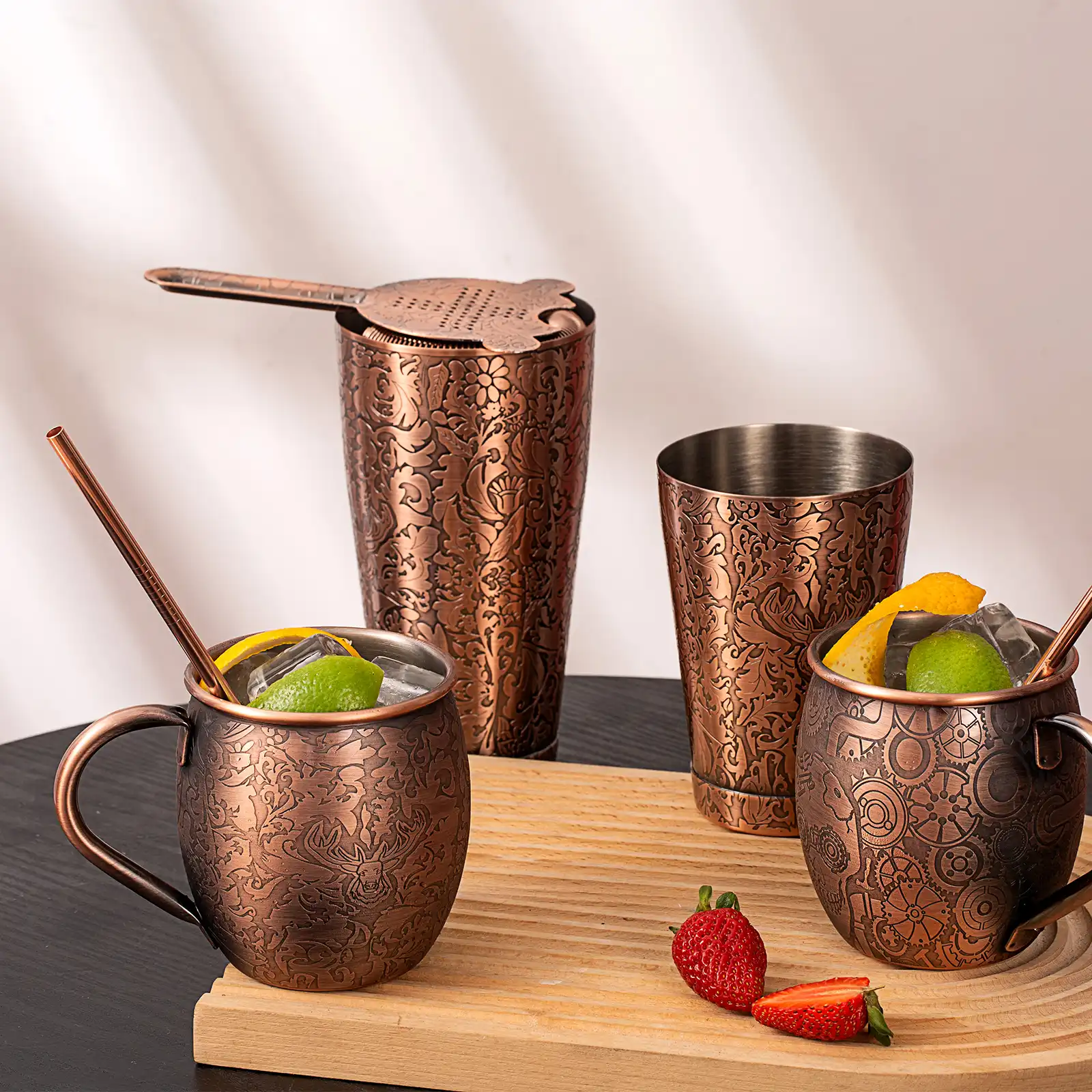
2. Professional Bar Tools: Boston Cocktail Set
Professional bars more commonly use the two-section Boston cocktail set.
Typically:
One large stainless steel mug
One small mug
Advantages:
Tight seal
Quick dispensing
Easy to disassemble and clean
Stable during peak hours

Professional bars emphasize speed and continuous operation, and Boston is better suited to this pace.
From a durability perspective, the stainless steel tin-in-tin structure is more suitable for high-frequency commercial environments.
II. Cocktail Accessories Selection
The difference in tools isn’t just about the cocktail shaker itself; the choice of accessories is also crucial.
1. Jigger
The way a bartender measures drinks can reveal their habits.
Professional bartenders
Experienced bartenders sometimes rely on feeling to pour drinks.
After long-term training, they develop muscle memory for the volume.
However, even in professional bars, jiggers are still used in most cases, especially:
During the development of new products, when precise measurement requirements are high
In chain stores with strict regulations
In environments with strict cost control
General bartenders
Most bartending operations rely on jiggers for precise volume control.

Advantages:
Stable mixing ratios
Consistent flavor
Controlled waste
In a commercial environment, consistency is more important than simply showcasing skill.
2. Choosing a Strainer
The differences in strainers are quite noticeable.
Professional bartenders commonly use three types of strainers:
Hawthorne Strainer
Used with a Boston Shaker, the most common.
Julep Strainer
Suitable for stirred cocktails.
Fine Strainer
Double filtration, resulting in a cleaner taste.
Professional bars usually have all three types.
General bartenders
If using a cobbler, they will use the built-in strainer.
The advantage is simplicity, the disadvantage is limited filtration fineness.
Sufficient for home use, but may not be fine enough for professional production.

3. Other Cocktail Tools
Besides the core tools, these include:
Bar spoon
Muddler
Ice tongs
Mixing glass
Pours
Professional bars usually choose durable stainless steel for easy cleaning and high-frequency use.
III. E-Bon’s Large-Scale Manufacturing of Bar Tools
For distributors, brand owners, and bar supply wholesalers, the professionalism of the tools is only one aspect.
More crucial is supply capability.
Ebang has focused on manufacturing stainless steel bar tools for 25 years, primarily serving B2B clients.
Its advantages mainly lie in:
In-house production system
Stable large-scale production capacity
OEM/ODM support
Customization options include laser engraving, etching, and electroplating
Support for factory inspections and long-term supply partnerships
Whether it’s a beginner’s bartender’s set or a professional Boston bartender series, we can handle mass production and stable delivery.
For wholesale channels, consistent supply capability and quality are more important than single orders.
Leave a Reply